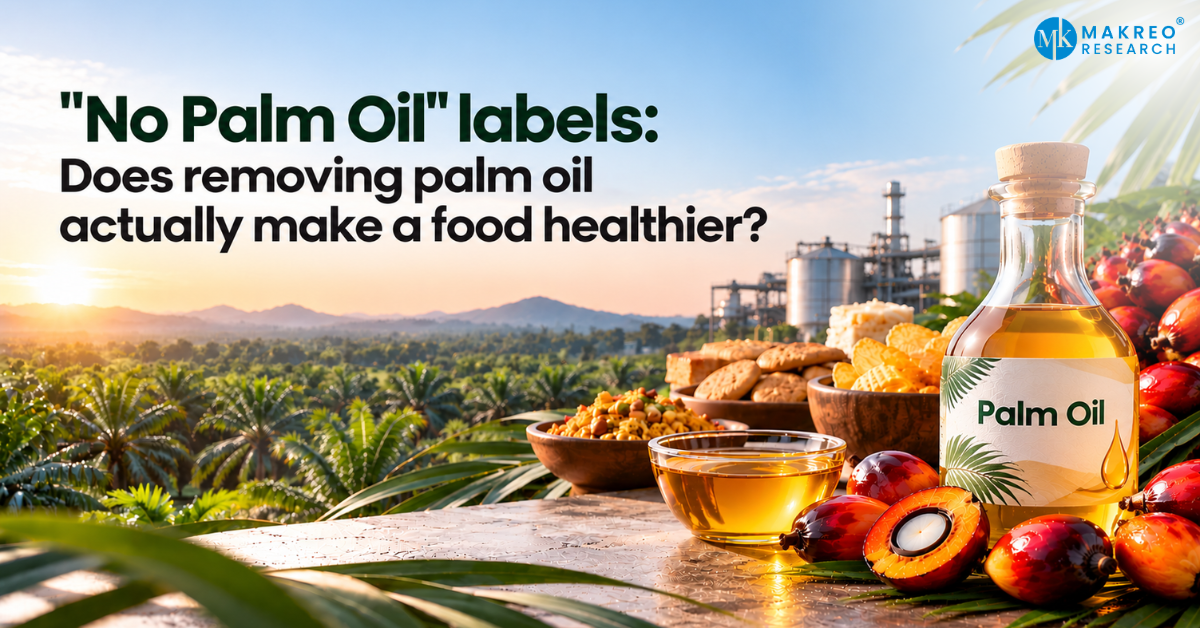
Palm oil is one of the world’s most widely used edible oils, yet its nutritional and functional benefits remain widely misunderstood.
MUMBAI, MAHARASHTRA, INDIA, October 1, 2026 /EINPresswire.com/ — “No Palm Oil” is becoming a familiar promise on Indian food packaging. From biscuits and namkeen to ready-to-eat snacks, brands are using the phrase as moniker for “healthier”, sans evidence that the reformulated product is nutritionally superior than the one it replaced.
The claim tells shoppers what has been taken out. It rarely tells them what has gone in instead, or whether the resulting product is any lower in saturated fat, sugar, sodium or calories.
The result is a marketing narrative that has moved ahead of the science. It misleads the consumers about an oil that accounts for more than one-third of India’s edible oil consumption.
“The growing use of ‘No Palm Oil’ claims has introduced a simplified way of communicating food quality, but the absence of palm oil does not, by itself, establish that a product has a better nutritional profile. A reformulated product may replace palm oil with another fat while simultaneously changing other aspects of its formulation, including sodium, additives or the degree of processing.”
– Dr Vishal Malhotra, Senior Healthcare Consultant, Makreo Research
What gets lost in this debate is what palm oil actually offers. Several of its qualities remain little known to most consumers:
• Naturally free of industrial trans fats: unlike partially hydrogenated oils, palm oil needs no hydrogenation to become semi-solid, making it a key ally in removing trans fats from Indian diets.
• A balanced fat profile: about 40–45% of its fat is monounsaturated, the same type found in olive and groundnut oil, alongside 40–50% saturated fat.
• Stable at high heat: its low polyunsaturated content means it breaks down more slowly during frying, forming fewer degradation products in the oil that reaches the plate.
• A natural source of antioxidants: palm oil contains tocotrienols, a form of vitamin E, and unrefined red palm oil is one of the richest plant sources of beta-carotene, a precursor of vitamin A.
A “No Palm Oil” claim says nothing about a product’s overall nutritional profile. The World Health Organization’s guidance on dietary fats focuses on total saturated and trans-fat intake across the whole diet, not on avoiding any single oil.
Separating Marketing from Evidence
To understand the nuances behind these claims, Makreo Research conducted a scientific review of the evidence on palm oil and has released its findings in a new white paper. The study examines palm oil across four areas: nutrition and dietary fats, cardiovascular health, frying and food-safety performance, and its role in India’s trans-fat reformulation and edible-oil supply.
Understanding Palm Oil’s Role in a Balanced Diet and Modern Food System
Palm oil’s widespread use across household cooking, food processing, food service and hotel, restaurant and catering (HoReCa) applications reflects its functional versatility and relevance to India’s evolving food landscape. Its suitability for different food applications, together with its role in cooking and food formulation, makes it an important edible oil to evaluate within the broader context of nutrition and food-system requirements.
Key Facts on Palm Oil in India:
1. Palm Oil Fatty-Acid Profile
– Key fact: Approximately 40–50% saturated fatty acids (SAFA), 40–45% monounsaturated fatty acids (MUFA), and 10–12% polyunsaturated fatty acids (PUFA).
– Why it matters: Its relatively lower PUFA content provides distinctive oxidative stability compared with PUFA-rich oils.
2. Industrial Trans Fats
– Key fact: Palm oil is naturally free of industrial trans fats.
– Why it matters: This distinguishes it from partially hydrogenated
3. Frying Stability
– Key fact: Palm olein’s relatively low PUFA content supports higher oxidative stability and slower formation of frying degradation products.
– Why it matters: This makes it particularly relevant for high-temperature frying, food processing, and commercial kitchens.
Palm Oil and Cardiovascular Health: What the Evidence Reveals
The scientific evidence reviewed in the white paper published by Makreo Research provides a more nuanced perspective on palm oil and cardiovascular health. The literature does not establish a consistent independent association between palm oil consumption and coronary heart disease, stroke or cardiovascular mortality.
The assessment also finds that the effects of palm oil on blood lipids vary depending on the comparison oil and dietary context. These findings highlight the importance of considering palm oil within the context of an overall dietary pattern rather than evaluating it in isolation.
The clinician perspectives reviewed in the white paper reflect this broader approach. Rather than focusing on individual dietary ingredients, including palm oil, the perspectives emphasise moderation, balanced dietary patterns, overall fat intake, portion size, cooking practices, and lifestyle factors.
Why Palm Oil Deserves a More Informed Place in the Nutrition Conversation?
Palm oil is naturally semi-solid at room temperature and can be fractionated into palm olein (liquid) and palm stearin (solid). This allows manufacturers to obtain different melting points, textures and functional properties. Its balanced saturated and unsaturated fatty acid profile also contributes to resistance to oxidative degradation during high-temperature cooking. These characteristics help explain why palm oil and its fractions became important alternatives when PHOs, the major source of trans fats in the diet, were removed from food formulations.
Discussion points towards a more balanced understanding of palm oil one that recognises its functional utility in food applications, its naturally trans-fat-free profile, its role in cooking and food formulations, and the importance of responsible consumption. This evidence-led perspective moves the conversation beyond a simple “yes or no” judgement and towards a more meaningful question: how can palm oil be used appropriately as part of a balanced diet?
Moving the Conversation Forward
Taken together, the evidence supports a more balanced understanding of palm oil: one that recognises its functional value, its naturally trans-fat-free profile, its role in cooking and food formulation, and the importance of responsible consumption.
The Full White Paper is available at Evaluating Palm Oil in India: Health Evidence, Dietary Context, and Misconceptions.
Saurabh Adsule
Makreo Research and Consulting
+91 8108868109
email us here
Visit us on social media:
LinkedIn
Other
Legal Disclaimer:
EIN Presswire provides this news content “as is” without warranty of any kind. We do not accept any responsibility or liability
for the accuracy, content, images, videos, licenses, completeness, legality, or reliability of the information contained in this
article. If you have any complaints or copyright issues related to this article, kindly contact the author above.

Media gallery