North America remains the largest market for bike scooter rentals, driven by urbanization and changing consumer preferences.
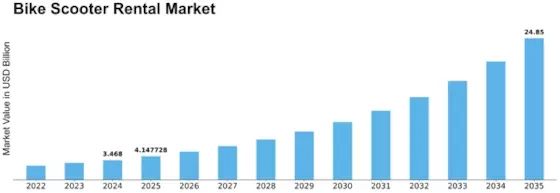
NEW YORK, NY, UNITED STATES, September 8, 2026 /EINPresswire.com/ — According to Market Research Future, the Bike Scooter Rental Market is expected to reach USD 24.85 Billion, at a CAGR of 19.60% by driving industry size, share, sales, revenue, trends, regional analysis, top companies, growth drivers, segments and forecast 2025 to 2035. This exceptional growth trajectory reflects the accelerating global shift toward micro-mobility solutions, where bike and scooter rental services are transforming urban transportation by offering flexible, eco-friendly alternatives to traditional commuting methods. The market’s rapid expansion is underpinned by increasing urbanization, the rising demand for first- and last-mile connectivity solutions, supportive government policies promoting sustainable transport, and the growing integration of rental services with tourism and institutional partnerships.
Market Overview
The bike scooter rental market encompasses shared mobility services that provide bicycles, electric scooters, and other micro-mobility vehicles for short-term rental use, typically accessed through smartphone applications. These services have emerged as critical components of urban transportation ecosystems, addressing the “last mile” connectivity gap between public transit hubs and final destinations. The market includes pay-as-you-go and subscription-based service models, pedal, electric, and gasoline propulsion options, as well as dockless and station-based operational frameworks.
Tourism sector integration has unlocked significant market opportunities. The infusion of bike and scooter rental services into tourism offerings was leveraged in 2023 when guided micromobility tours were introduced in major European and Asian destinations. In 2026, partnerships with hotels and travel agencies were being formalized to provide rental fleets directly at booking touchpoints. These initiatives have shown that micromobility can evolve from general urban transport into curated sightseeing experiences, with providers positioned to capture value through convenient, accessible mobility bundles tailored to visitor preferences and trip itineraries.
Government policies and environmental sustainability goals are accelerating market adoption. Supportive government policies, including incentives, subsidies, and relaxed regulations for electric mobility, have encouraged both service providers and consumers to transition to electric fleets. The environmental sustainability of electric vehicles has aligned with the growing commitment of cities to reduce air pollution and carbon emissions. The combination of environmental, economic, and policy-driven factors has ensured the continued dominance of electric propulsion in the micromobility ecosystem. The Motorcycle Rental Market represents a complementary segment within the broader shared mobility landscape, catering to consumers seeking longer-range and more powerful two-wheeled rental options for tourism and extended journeys.
📍 Get Free Sample Report for Detailed Market Insights:
https://www.marketresearchfuture.com/sample_request/12237
Market Segmentation
The bike scooter rental market is segmented based on service, propulsion, operational model, vehicle, application, and regional analysis to provide a comprehensive understanding of the industry landscape.
By Service: The market is categorized into Pay as You Go and Subscription-Based. Pay-as-you-go services have emerged as the dominant segment, characterized by their flexibility and ease of use. This model allows users to find and rent scooters via mobile apps, paying per trip without the commitment of a subscription. Operators have favored this model due to its low customer acquisition cost and high user turnover, leading to improved fleet utilization rates. As consumers continue to prioritize convenience, transparency, and cost efficiency, the pay-as-you-go service format has remained the preferred choice across both mature and emerging urban centers. Subscription-based services, while currently smaller, are gaining traction among regular commuters seeking predictable monthly costs and guaranteed vehicle availability.
By Propulsion: The market is divided into Pedal, Electric, and Gasoline. Electric propulsion has established its dominance in the bike scooter rental sector, largely due to advancements in battery technology and growing urban demand for sustainable transport. The electric propulsion segment is expected to command 72% of the Bike and Scooter Rental market revenue share in 2026, establishing it as the leading propulsion type. Growth in this segment has been influenced by increasing demand for zero-emission transportation and rising fuel prices, which have accelerated the shift toward electric alternatives. Advancements in battery technology have extended travel ranges and reduced charging times, enhancing the user experience and operational efficiency. Pedal-powered options are emerging as a favorite among environmentally-conscious users who prioritize physical activity and green transportation. The trend toward pedal bikes is further fueled by urban initiatives promoting cycling and fitness, positioning them as an appealing alternative in cities aiming for reduced carbon footprints. Gasoline-powered vehicles represent a declining segment as cities implement stricter emission regulations and consumers increasingly favor cleaner alternatives.
By Operational Model: The market is segmented into Dock Less and Station-Based. Dockless models hold the largest market share, favored for their convenience and flexibility. The dockless operation model segment is forecasted to capture 64% of the Bike and Scooter Rental market revenue share in 2026, positioning it as the leading operational framework. This model allows users to pick up and drop off vehicles at any legal public location without requiring fixed docking stations, with GPS-enabled mobile applications enhancing user flexibility and leading to greater trip volumes per vehicle. From an operator’s perspective, the dockless model has enabled faster scaling and reduced infrastructure investment compared to station-based systems. Station-Based models are gaining traction as a faster-growing segment, appealing to urban commuters who prefer a structured approach to vehicle availability. While they may lack the spontaneity of dockless options, station-based rentals are finding favor in areas with high foot traffic, offering users a reliable alternative that enhances predictability in scooter access.
By Vehicle: The market is categorized into Bike, Scooter, and Others. The bike segment has established its dominance in the bike scooter rental market, favored for its ability to serve both leisure and commuting purposes efficiently. With a strong network of rental stations, bikes cater to a broad demographic, from tourists to daily commuters. Scooters are the fastest-growing segment, gaining traction especially among urban commuters seeking convenience and efficiency. Scooters emerge as a favorite among younger consumers and urban dwellers, driven by the need for quick and flexible transportation options. Their compact size and ease of use position scooters as an attractive alternative, especially in congested city areas, indicating a potential shift in rental preferences in the near future.
By Application: The market is segmented into Short Trip (Less Than 5 km), Medium Trip (5 km to 15 km), and Long Trip (More Than 15 km). The short trip segment commands a significant share due to its convenience and high frequency of use among urban commuters. This segment benefits from the rising popularity of eco-friendly transportation methods amidst bustling city environments, with scooters offering a nimble solution for short commutes or errands. Long trips, stretching beyond 15 km, represent the fastest-growing segment as an increasing number of riders seek alternative modes for longer distances, spurred by improving infrastructure and the affordability of rental options. This segment attracts customers seeking flexibility and adventure, bolstered by an increasing interest in sustainable travel options and the expanding availability of charging stations along key routes. The Bike Scooter Rental Market continues to evolve as consumer preferences shift toward micro-mobility solutions that meet the demands of modern transportation across all trip lengths.
By Region: The market analysis covers North America, Europe, Asia-Pacific, and Rest of the World. North America dominated the bike scooter rental market in 2022, accounting for 45.80% of global market share. Asia-Pacific is expected to witness the highest growth, driven by rapid urbanization and government initiatives promoting sustainable mobility.
🛒 You can buy this market report at:
https://www.marketresearchfuture.com/checkout?currency=one_user-USD&report_id=12237
Regional Analysis
North America held the dominant position in the bike scooter rental market in 2022, accounting for approximately 45.80% of global market share. The region’s leadership is driven by numerous cities with sizable networks of buses, commuter trains, and subways, where bike and scooter rentals fill the critical void in first- and last-mile connectivity. Riders can rent a scooter to get to a subway station quickly, improving the appeal and ease of public transportation. The United States holds the largest market share within the region, followed by Canada, supported by robust urban mobility infrastructure and high consumer adoption of micromobility solutions. The competitive landscape features key players such as Lime, Bird, and Spin, which dominate the market with innovative platforms and extensive fleet networks.
Europe represents a mature and rapidly growing market, characterized by strong government support for sustainable urban mobility and deeply rooted cycling culture. Germany leads regional consumption with a projected CAGR of 17.3%, followed by France at 15.8% and the United Kingdom at 14.3%. The European Union’s commitment to reducing carbon emissions and promoting active transportation has driven substantial investment in cycling infrastructure and shared mobility services. The extension of government-supported rental trials has helped develop regulatory blueprints and scale up shared mobility operations across the region.
Asia-Pacific emerges as the fastest-growing regional market, driven by massive urban populations, rapid economic development, and aggressive government initiatives promoting electric mobility. China leads the region with a projected CAGR of 20.3%, followed by India at 18.8%. China’s dominance is supported by world-class manufacturing capabilities, including Yadea and AIMA’s established production, high smartphone and mobile payment penetration, and proactive government promotion of shared mobility as a solution to urban congestion. India’s explosive growth is fueled by rapid urbanization, traffic congestion, the popularity of the Ola Electric S1 scooter, and continued investments in public charging infrastructure. The competitive landscape features both global players and local manufacturers such as Ola Electric and Hero Electric, which benefit from cost advantages and local market understanding.
Rest of the World, encompassing Latin America, the Middle East, and Africa, represents emerging markets with substantial growth potential. Latin American markets, particularly Brazil and Mexico, show steady growth supported by improving urban infrastructure and increasing consumer adoption of shared mobility services. The Middle East demonstrates growing interest in micromobility solutions as cities invest in sustainable transportation infrastructure. African markets remain at nascent stages but hold potential as urbanization accelerates and digital infrastructure develops.
Competitive Landscape and Key Players
The bike scooter rental market is highly competitive, featuring a mix of established global operators, regional players, and emerging technology companies. Leading companies are focusing on fleet expansion, technological innovation, strategic partnerships, and service diversification to strengthen their market positions.
Key players operating in this space include Bird Rides, Inc., Lime, Spin (owned by Ford Motor Company), Tier Mobility, Voi Technology, Bolt, Dott, and Neuron Mobility. These industry leaders leverage their extensive fleet networks, sophisticated mobile platforms, and strong relationships with city governments to maintain dominant market positions in key urban centers.
Strategic developments are reshaping the competitive landscape. Major operators are forming partnerships with city governments to establish regulated micromobility programs that ensure orderly fleet management and community integration. Acquisitions and mergers are consolidating market presence in key regions, enabling companies to achieve economies of scale and expand service coverage. The integration of artificial intelligence and data analytics is enabling optimized fleet distribution, predictive maintenance, and dynamic pricing strategies that improve operational efficiency and profitability.
Latest Industry News and Developments
Recent industry developments reflect the dynamic nature of the bike scooter rental market. In 2026, extensions of government-supported rental trials were introduced in several countries to develop regulatory blueprints and scale up shared mobility operations. These developments have shown that rising commuter volume, paired with structured municipal involvement, has fueled market expansion, with the shift toward flexible, short-distance mobility becoming a recurring demand reinforced by transit system gaps.
By early 2026, integrated booking platforms were facilitating on-demand access via vacation packages, boosting usage among international travelers. These initiatives have shown that micromobility can evolve from general urban transport into curated sightseeing experiences, with providers positioned to capture value by offering convenient, accessible mobility bundles tailored to visitor preferences and trip itineraries.
The industry continues to witness increasing adoption of electric vehicles, with electric propulsion expected to command 72% of the market revenue share in 2026. Supportive government policies, including incentives, subsidies, and relaxed regulations for electric mobility, have encouraged both service providers and consumers to transition to electric fleets, creating substantial opportunities for market expansion.
Market Challenges and Opportunities
The bike scooter rental market faces several challenges that could impact growth trajectories. Regulatory uncertainty and evolving city ordinances create operational complexities for operators, as different municipalities implement varying rules regarding fleet size, parking requirements, and operational hours. Vehicle vandalism, theft, and vandalism present significant operational challenges, requiring robust security measures and fleet maintenance programs. Profitability remains a concern for many operators, as pricing pressures and operational costs can impact margins.
Emerging opportunities are abundant in the evolving market landscape. The integration of bike and scooter rental services with public transit systems offers substantial growth potential for first- and last-mile connectivity solutions. The expansion of tourism partnerships and institutional collaborations presents opportunities for predictable, high-frequency demand across leisure and organizational segments.
Future growth potential remains exceptionally strong, driven by the continuous evolution of urban mobility, increasing environmental awareness, and the transformation of cities toward sustainable transportation ecosystems. As cities continue to invest in cycling infrastructure and governments implement policies promoting active mobility, the bike scooter rental market is well-positioned for sustained expansion throughout the forecast period and beyond.
To explore more market insights, visit us at:
https://www.marketresearchfuture.com/reports/bike-scooter-rental-market-12237
Final Market Summary
Key factors expected to influence future development include the pace of urban infrastructure investment, advancements in electric vehicle technology, and the evolution of regulatory frameworks governing shared mobility. Consumer preferences for convenient, affordable, and environmentally friendly transportation solutions will continue to drive innovation across all service segments. Government initiatives promoting sustainable transport and active mobility will play a crucial role in shaping market trajectories.
The transition toward sustainable urban mobility represents a fundamental shift in transportation paradigms, positioning bike and scooter rental services as critical enablers of clean, efficient, and accessible city living. As cities continue to prioritize low-emission transport and active mobility, the importance of flexible, technology-enabled micromobility solutions will only continue to grow, ensuring robust demand and market expansion throughout the forecast period and beyond.
More Related Reports from MRFR Library:
Automotive Leaf Spring Market : https://www.marketresearchfuture.com/reports/automotive-leaf-spring-market-8135
Electric Three Wheeler Market : https://www.marketresearchfuture.com/reports/electric-three-wheelers-market-8141
Electric Vehicle Thermal Management System Market : https://www.marketresearchfuture.com/reports/electric-vehicle-thermal-management-system-market-8151
Mild Hybrid Vehicles Market : https://www.marketresearchfuture.com/reports/mild-hybrid-vehicles-market-8152
Acoustic Vehicle Alerting Systems Market : https://www.marketresearchfuture.com/reports/acoustic-vehicle-alerting-systems-market-8161
Door Control Modules Market : https://www.marketresearchfuture.com/reports/door-control-modules-market-8275
Low Rolling Resistance Tire Market : https://www.marketresearchfuture.com/reports/low-rolling-resistance-tire-market-8277
Hybrid EV Battery Market : https://www.marketresearchfuture.com/reports/hybrid-ev-battery-market-8288
Dump Truck Market : https://www.marketresearchfuture.com/reports/dump-truck-market-8314
Adaptive Headlights Market : https://www.marketresearchfuture.com/reports/adaptive-headlights-market-8322
Market Research Future
Market Research Future
+1 855-661-4441
email us here
Legal Disclaimer:
EIN Presswire provides this news content “as is” without warranty of any kind. We do not accept any responsibility or liability
for the accuracy, content, images, videos, licenses, completeness, legality, or reliability of the information contained in this
article. If you have any complaints or copyright issues related to this article, kindly contact the author above.

Media gallery