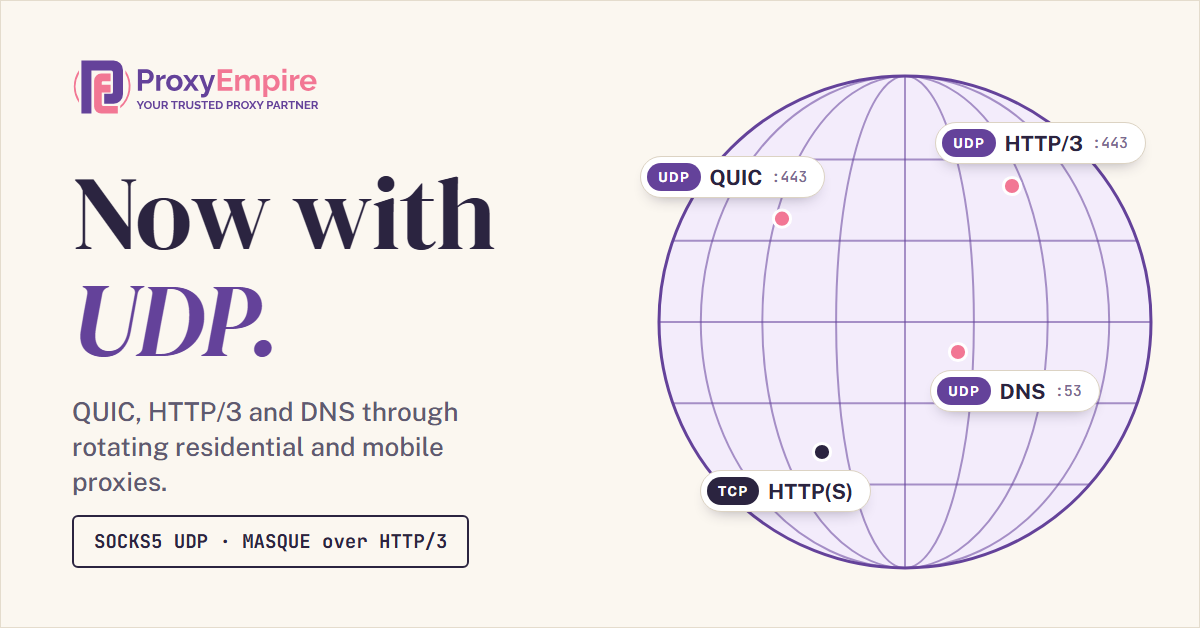
Rotating residential and mobile proxies now carry QUIC, HTTP/3 and DNS traffic through SOCKS5 UDP or a MASQUE tunnel, on the same login.
BURGAS, BULGARIA, November 19, 2026 /EINPresswire.com/ — ProxyEmpire, a proxy provider with more than 30 million residential IPs and 4 million mobile IPs, has added User Datagram Protocol (UDP) support to its rotating residential proxies and rotating mobile proxies. Besides ordinary connections, the proxies now carry QUIC, HTTP/3 and DNS traffic, through the SOCKS5 UDP ASSOCIATE command or a MASQUE tunnel over HTTP/3. UDP support is available now to every customer on these two products.
UDP is the transport behind QUIC, the protocol that HTTP/3 runs on, and behind most Domain Name System (DNS) lookups. Many residential proxy networks carry Transmission Control Protocol (TCP) traffic only. Through them, an HTTP/3 client falls back to HTTP/2, and tools that need UDP do not work at all. With UDP on its residential and mobile pools, ProxyEmpire lets QUIC and DNS traffic leave from real home broadband and 4G/5G mobile IPs, with the same pools and targeting as the rest of a project’s traffic.
There are two ways to send UDP. Clients and libraries that support UDP over SOCKS5 use the UDP ASSOCIATE command. HTTP/3-native clients can open a MASQUE tunnel, an IETF standard (RFC 9298) that carries UDP inside an HTTP/3 connection. Both use the same proxy gateway, username and password as TCP traffic. Targeting by country, region, city, ZIP code, internet service provider (ISP) or mobile carrier, autonomous system number (ASN) and sticky sessions works the same way as over TCP, and UDP traffic counts against the same GB balance with no extra fee.
Typical uses include sending DNS queries from a chosen country, city or network to see the answers local users get from geo-aware DNS and content delivery networks; checking that QUIC is offered and answered correctly in each market over real consumer connections; measuring QUIC handshakes and response times from residential and mobile networks; and keeping HTTP/3 end to end in tools that speak QUIC, instead of falling back to HTTP/2.
UDP ports 443 (QUIC and HTTP/3) and 53 (DNS) are open by default. Other UDP ports can be opened after a Know Your Customer (KYC) check and a review of the use case. Online games, voice calls and browser-based real-time communication (WebRTC) use other ports, so they do not go through the proxy by default. Browsers do not send UDP through a SOCKS5 proxy, so UDP needs a client or library that supports SOCKS5 UDP or MASQUE. ISP, datacenter, dedicated mobile and unlimited residential proxies continue to carry TCP only.
“More and more tools speak HTTP/3 over QUIC, and a TCP-only proxy pushes them back to HTTP/2,” said a ProxyEmpire spokesperson. “Adding UDP to our residential and mobile pools lets that traffic go through the proxy too, with the same login and targeting customers already use.”
The $1.97 trial, with 100 MB of residential and 50 MB of mobile data that never expires, includes UDP. Code examples for both methods are in ProxyEmpire’s guide to UDP proxies.
About ProxyEmpire
ProxyEmpire provides rotating residential, rotating mobile, static residential (ISP), rotating datacenter, unlimited residential and dedicated mobile proxies for web data collection, market research, ad verification, search engine optimization (SEO) and location-specific testing. Its network has more than 30 million residential IPs and more than 4 million mobile IPs in over 170 countries, with 99.9% uptime and 24/7 support from real people. Customers can also manage their proxies from AI assistants through ProxyEmpire’s free Model Context Protocol (MCP) server. Rotating residential plans start at $1.50 per GB, and a $1.97 trial is available. More information: https://proxyempire.io/
ProxyEmpire Team
ProxyEmpire
Visit us on social media:
LinkedIn
Instagram
Facebook
YouTube
X
Other
Legal Disclaimer:
EIN Presswire provides this news content “as is” without warranty of any kind. We do not accept any responsibility or liability
for the accuracy, content, images, videos, licenses, completeness, legality, or reliability of the information contained in this
article. If you have any complaints or copyright issues related to this article, kindly contact the author above.

Media gallery