

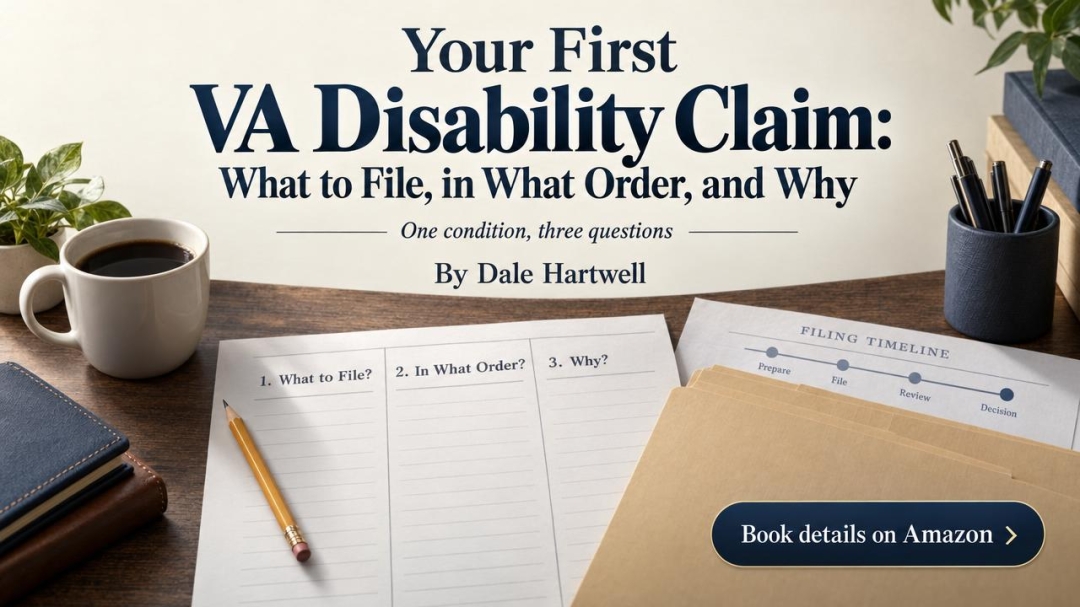
HOUSTON, TX – Nov. 27, 2026 – Dale Hartwell’s new book, Your First VA Disability Claim: What to File, in What Order, and Why, was published November 16, 2026. Written for veterans applying for disability compensation for the first time, Hartwell’s first VA disability claim guide addresses a practical difficulty: a veteran may remember an injury and know what still hurts without knowing which piece of paperwork to handle first. The book follows a claim from protecting a potential filing date through reading a decision letter, with an action at the end of each chapter.
The starting point is a list in the veteran’s own words, not a completed application. Hartwell distinguishes a symptom someone can describe from a diagnosis a clinician has made. A person who notices burning and numbness in one hand can record which hand is affected, roughly when the sensation began, and what it interferes with. That observation belongs on the working list even if its cause is unknown. The same approach makes room for changes in sleep, concentration, or behavior that have become so familiar the veteran might otherwise leave them out. Hartwell treats unexplained symptoms as reasons to seek evaluation rather than guess at a medical label.
What does an intent to file confirmation tell me? It identifies the benefit recorded and the date VA received the intent. Those details give the veteran a starting point for tracking the deadline for the completed application. In Hartwell’s filing timeline, the confirmation sits alongside later entries for the application, uploads, and letters. Keeping the entries distinct matters: a reader looking back at the file can tell the date of the initial intent from the date the application itself was submitted.
Before turning to the evidence, the guide addresses the choice between filing independently and asking for help. Hartwell suggests finding out who will review the records and prepare the forms, then checking that individual’s accreditation rather than relying on a business name. The discussion gives veterans concrete questions to ask, including whether they will see the application before it is filed and how they can get their records back. A promised rating or a request for an account password is a warning sign, not a reason to hand over the file.
At the center of the book is a three-column worksheet for each condition. One column describes the current disability, another the event or circumstances during service, and the third the evidence connecting the two. The reader marks each column complete, partial, or missing. Beside each gap goes a specific next task. In Hartwell’s example, a broad intention to gather more evidence becomes a request for sick-call records from a particular base clinic and year. The reader can then log the request and its response instead of starting the search over when the file is reopened.
The purpose of a record matters as much as its source. A letter written during training might help establish when someone first described difficulty walking. A pharmacy record might help reconstruct a treatment timeline, while an employment physical might document a limitation after discharge. Those records speak to different questions; none should be made to say more than it does. Where a clinic name or an exact date has slipped from memory, the book favors an honest date range and an account of what the veteran remembers over an invented detail.
When the sequence reaches VA Form 21-526EZ, the working list serves a different purpose. Readers return to it with their records in hand and decide how to name each condition on the application. Hartwell explains why a documented diagnosis and the affected side of the body convey more than a general reference to leg trouble. Where there is no diagnosis, a plain description of the symptom remains useful. The submission step includes saving a copy of the application and proof of submission so the veteran can later identify what was sent.
How is a VA examiner different from a VA rater? The compensation and pension examiner documents findings about a condition and, when asked, provides a medical opinion. The rater decides the claim using the examination report along with the other evidence in the file. For the veteran preparing for that appointment, the task is to explain what happens on typical days and on worse days, without presenting either as the whole picture. During the waiting period, the guide suggests a regular status check and a single place for exam notices, correspondence, and receipts.
Readers can recreate the Appendix B worksheets in a notebook or spreadsheet or print copies to keep with a paper file. A closing filing-order checklist brings the sequence back to one page. The guide is educational rather than individual legal or medical advice, and it directs readers to confirm current forms and deadlines at VA.gov or with an accredited representative. Book details for Your First VA Disability Claim: What to File, in What Order, and Why are available at https://www.amazon.com/dp/B0HRTCFS9K. Additional book information is available through Book website.
About Dale Hartwell
Dale Hartwell is the author of Your First VA Disability Claim: What to File, in What Order, and Why. Hartwell writes for veterans preparing an initial disability compensation claim, using filing timelines, evidence worksheets, and plain-language examples to explain how to organize records and describe the effects of a condition on daily life.
Video Link: https://www.youtube.com/embed/qc6mpYbmzsk
Media Contact
Company Name: Your First VA Disability Claim
Contact Person: Dale Hartwell
Email: Send Email
Phone: 713-392-6222
Address:450 N Sam Houston Prky E Ste 103
City: Houston
State: TX
Country: United States
Website: https://wjllznpzedhsbg1n6voh9o1x.macaly.app/
Press Release Distributed by ABNewswire.com
To view the original version on ABNewswire visit: Dale Hartwell’s new guide explains what to file first in a VA disability claim