
SHENZHEN, GUANGDONG, CHINA, November 26, 2026 /EINPresswire.com/ — Top 5 Criteria For Selecting A China Top 48 Fiber MTP Breakout Cable Exporter
Global data center operators and enterprise telecommunication providers are accelerating their migration to ultra-high-density optical architectures to satisfy the escalating bandwidth demands of cloud computing, artificial intelligence processing, and 800G optical transceivers. As network engineering teams transition from traditional trunking solutions to high-density multi-fiber assemblies, selecting a reliable China Top 48 Fiber MTP Breakout Cable Exporter has become a pivotal strategic decision. A 48-fiber MTP-to-LC breakout cable consolidation merges multi-fiber density with individual duplex port connectivity, significantly reducing cable tray clutter and optimizing airflow inside server racks. However, manufacturing high-core-count optical harnesses requires exacting precision, advanced polishing techniques, and rigorous optical testing. Consequently, evaluating prospective Chinese export manufacturers requires a systematic methodology rooted in engineering performance, quality assurance, and customization capability rather than simple unit price comparisons.
The High-Density Architecture Challenge: Why 48 Fiber MTP Breakout Cables Demand Stricter Sourcing Standards
Modern hyperscale environments and edge computing facilities are rapidly upgrading from legacy 100G networks to 400G, 800G, and future 1.6T transceiver speeds. High-density 48-fiber MTP breakout cable assemblies serve as the vital backbone in these environments, converting high-density multi-fiber MTP interfaces into multiple discrete LC connectors that attach directly to switches, servers, and patch panels.
Despite their spatial benefits, high-core breakout cables introduce complex structural engineering challenges. Packaging 48 individual optical fibers within a single compact harness increases susceptibility to micro-bending, port routing congestion, and signal cross-talk if internal strain relief is inadequate. Furthermore, a single defective fiber channel within a 48-core assembly can compromise multiple server links or stall an entire rack row, leading to costly operational downtime. Therefore, network architects must vet overseas manufacturing partners against stringent industrial criteria to guarantee long-term signal integrity and link stability.
Criterion 1: Precision Polarity Mapping (Type A/B/C) and Channel Alignment Capability
Ensuring absolute channel alignment across 48 distinct optical strands represents the first critical standard for evaluating an optical exporter. In complex multi-fiber deployments, polarity defines the continuous path of light from the transmitting laser at one end of the link to the receiving photodetector at the other. Standard industry polarity configurations, such as Type A (straight-through), Type B (fully flipped), and Type C (pair flipped), dictate precise pin positioning and fiber routing within the MTP connector body.
A failure in factory polarity mapping creates severe installation bottlenecks and can potentially damage sensitive optoelectronic hardware. Leading manufacturers employ automated optical mapping system checks during final assembly to verify pin alignment and fiber order across all 48 channels. A practical example of this stringent alignment requirement occurs in high-density cloud infrastructure deployments, such as a major Southeast Asian Data Center High-Density MPO Patch Cord expansion project where low-loss MPO-24 and MTP assemblies required absolute polarity accuracy to maintain uninterrupted transmission across high-throughput links. Suppliers that maintain total control over pin orientation and staggered fiber length management significantly reduce field troubleshooting time for installation crews.
Criterion 2: Comprehensive Optical Performance Verification (IL/RL & 3D Interferometer Testing)
Optical power budgets in high-speed networks have narrowed significantly, making Insertion Loss (IL) and Return Loss (RL) performance vital parameters. High-density breakout assemblies must maintain ultra-low loss thresholds to support tight system link budgets across complex patch panels and active equipment interfaces. Consequently, tier-one exporters implement strict optical performance validation protocols.
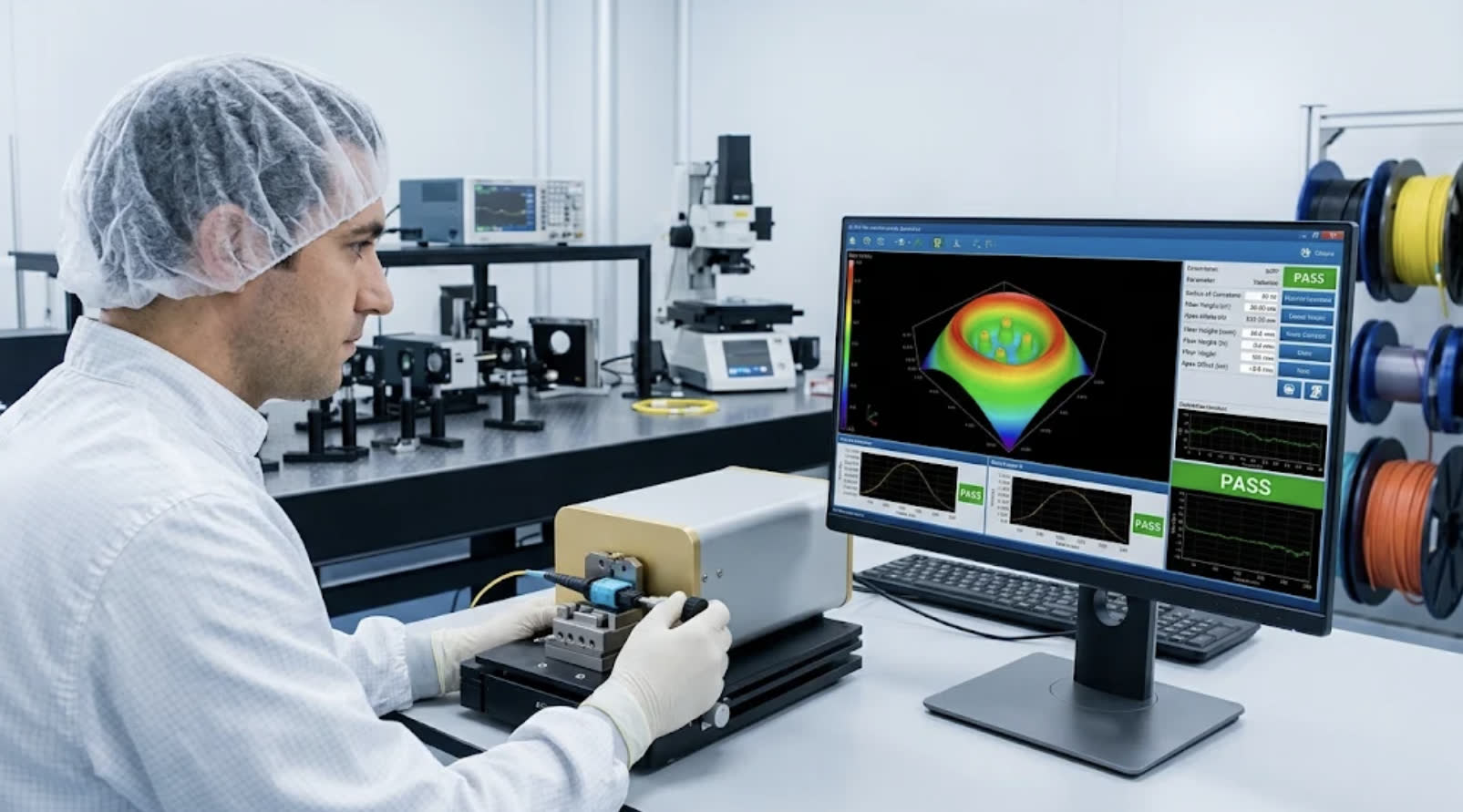
Superior quality control relies heavily on 3D optical interferometer testing, which measures crucial micro-geometric parameters of the polished ferrule end-face. Key parameters include apex offset, radius of curvature, and fiber core height protruding from or recessed into the ferrule. Proper ferrule geometry prevents microscopic air gaps, reduces physical interface friction, and ensures optimum physical contact. World-class manufacturers conduct 100% factory trace testing for both insertion loss and 3D end-face geometry, delivering individualized test certificates with every shipped order to verify compliance with international IEC standards.
Criterion 3: End-to-End Agile Customization & Cable Grade Flexibility
Data center layouts vary significantly across facilities, requiring tailored cable geometries rather than off-the-shelf, standardized products. A top-tier exporter must demonstrate agile customization capabilities, accommodating specific breakout staggered lengths, outer jacket flame ratings (such as LSZH or OFNP Plenum), and diverse outer diameter leg construction (ranging from 0.9mm to 2.0mm buffering).
Additionally, material flexibility extends to optical fiber types and specialized applications. While modern data centers predominantly utilize single-mode or OM3/OM4/OM5 multi-mode fibers, specific industrial systems or legacy infrastructure upgrades require specialized optical configurations, such as custom 48-core MTP-to-LC breakout jumpers built with OM1 multi-mode fiber or specialized 24-core breakout MTP-LC OM3 multi-mode assemblies. Experienced exporters maintain structured customization workflows, evaluating customer drawings, confirming technical drawings within 24 hours, and rapidly manufacturing custom prototype samples without disrupting mass production timelines.
Criterion 4: Ruggedized Packaging, Anti-Tension Protections, and On-Time Global Logistics
Physical protection during international transit represents an essential yet frequently overlooked selection criterion. High-density multi-fiber breakout cables feature delicate fan-out transition units and exposed LC connector legs that can easily sustain mechanical damage, micro-fractures, or dust contamination during long-distance ocean or air transport.
Qualified exporters utilize heavy-duty corrugated spools, moisture-proof anti-static bagging, and protective pulling socks designed to shield the fan-out transition and ferrule tips from mechanical tension. Pulling eyes distributed across the cable assembly allow installation teams to apply pulling force directly to internal strength members rather than the delicate optical fibers. Furthermore, established exporters maintain established relationships with international freight forwarders, ensuring transparent tracking, predictable lead times, and customs compliance for global delivery schedules.
Criterion 5: International Quality Certifications and Independent Third-Party Audit Compliance
The final criterion centers on robust quality management systems and verified regulatory compliance. Prospective buyers should thoroughly review an exporter’s factory certifications to ensure alignment with international environmental, safety, and manufacturing benchmarks. Core certifications include ISO 9001 for quality management systems, ISO 14001 for environmental management, and product-specific compliance marks such as CE, RoHS, and CPR (Construction Products Regulation) fire rating compliances.
Established manufacturers welcome independent pre-shipment quality audits and third-party product testing conducted by recognized organizations such as SGS or TUV. Exporters such as Fiber Hope (Fiber Hope Optical Communication Tech Co.,Ltd.) embed these international compliance standards throughout their manufacturing workflow, conducting continuous inline quality checks from raw fiber material inspection to final packaging verification. Partnering with a fully certified exporter guarantees that high-density breakout cable shipments meet global optical performance expectations reliably.
Executive Summary & Actionable Procurement Audit Checklist for 48 Fiber MTP Exporters
Selecting a premier Chinese exporter for 48-fiber MTP breakout cables requires a comprehensive assessment that balances advanced manufacturing capability against verified quality assurance. By evaluating technical polarity mapping, 100% 3D geometric testing, agile customization workflows, transit packaging durability, and international certifications, network engineers can secure long-term operational integrity for high-density optical infrastructures.
Procurement Audit Checklist for High-Density MTP Cable Exporters:
Polarity & Alignment Verification: Does the exporter provide automated polarity test reports verifying Type A, B, or C channel accuracy across all 48 cores?
100% 3D End-Face Inspection: Does the factory supply individual test certificates detailing Insertion Loss, Return Loss, and 3D interferometer geometric parameters (apex offset, curvature radius)?
Custom Geometry Support: Can the manufacturer customize fan-out staggered lengths, leg diameters (0.9mm/2.0mm), and jacket flame ratings (LSZH/OFNP) according to rack specifications?
Transit Protection Engineering: Are the breakout assemblies packaged with heavy-duty spools, protective pulling socks, and anti-tension strain relief units to prevent transit damage?
International Compliance & Audits: Does the exporter maintain active ISO 9001, CE, RoHS, and CPR certifications, and do they accept third-party pre-shipment inspections?
For detailed technical specifications, custom design options, and factory certifications regarding high-density optical assemblies, visit the official company website at https://www.cablefiberhope.com/.
Fiber Hope Optical Communication Tech Co., Ltd.
Fiber Hope Optical Communication Tech Co., Ltd.
Legal Disclaimer:
EIN Presswire provides this news content “as is” without warranty of any kind. We do not accept any responsibility or liability
for the accuracy, content, images, videos, licenses, completeness, legality, or reliability of the information contained in this
article. If you have any complaints or copyright issues related to this article, kindly contact the author above.

Media gallery