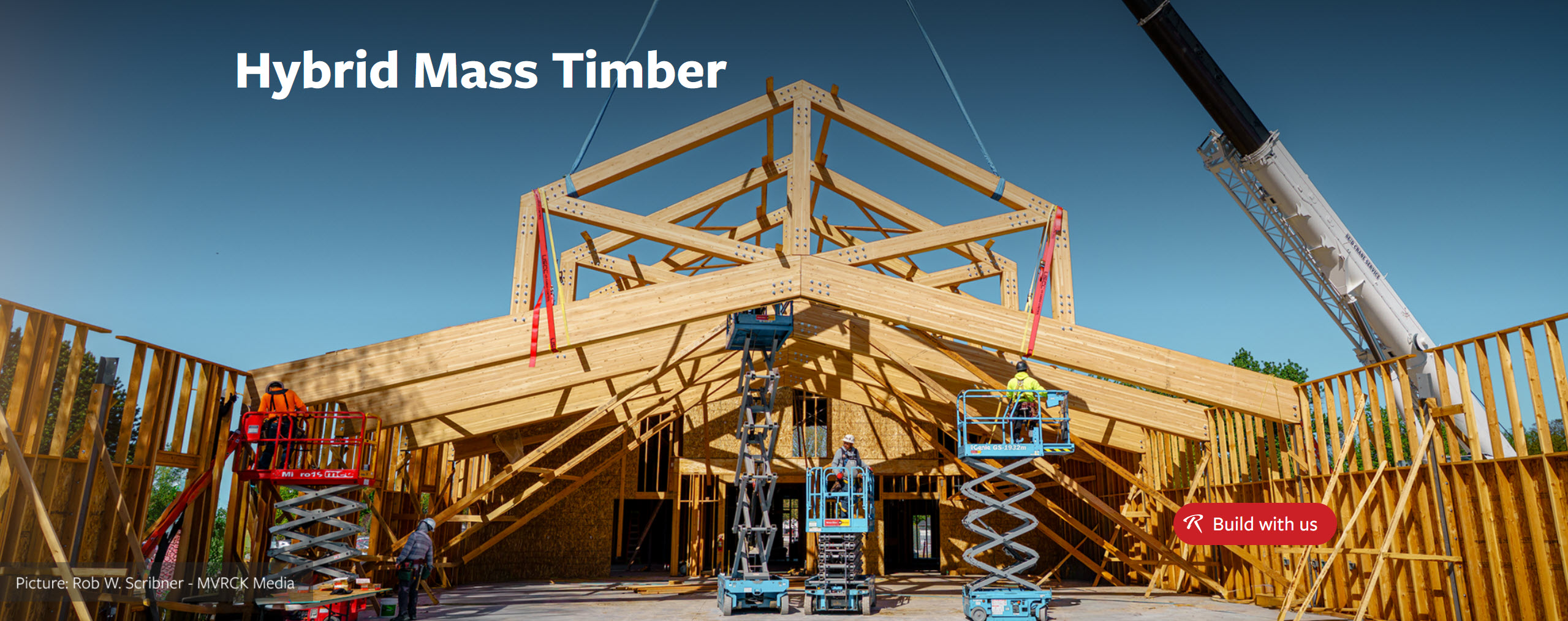

RedBuilt highlights hybrid mass timber systems that combine engineered wood performance, faster installation and lower-carbon commercial construction.
BOISE, ID, UNITED STATES, November 23, 2026 /EINPresswire.com/ — The mass timber construction sector continues its unprecedented expansion with U.S. project numbers growing approximately 20% annually since 2015, reaching over 2,500 buildings built or in progress across the United States as of 2025. This rapid growth reflects a fundamental shift in construction methodology as developers, architects, and builders increasingly turn to engineered wood products and composite lumber solutions to meet sustainability goals while maintaining structural integrity and design flexibility.
The global mass timber construction market stands poised to reach $1.3 billion by 2030, advancing from $990.4 million in 2024 at a compound annual growth rate of 4.8%. This expansion parallels the broader timber construction industry forecast, which projects market value to surge from $17.7 billion in 2025 to $44.2 billion by 2035, driven by increasing demand for sustainable building materials and green architecture solutions.
RedBuilt, a leader in engineered wood manufacturing, continues to support this transformation through advanced composite material systems including laminated veneer lumber, I-joists, and glued laminated timber products. The company’s involvement in large scale mass timber developments demonstrates the practical application of these technologies, with recent mixed use projects utilizing RedBuilt systems across 70,000 square feet of construction space.
“The acceleration we’re seeing in mass timber adoption represents more than a trend; it’s a fundamental reimagining of how we approach construction in terms of sustainability, efficiency, and performance,” said Hayley Dunning, Marketing Communications Specialist at RedBuilt. “Our engineered wood products provide the strength of materials necessary for modern building code requirements while significantly reducing carbon footprint compared to traditional steel and concrete alternatives.”
Cross-laminated timber and other prefabrication methods have revolutionized timber framing approaches, enabling faster construction timelines and reduced waste. These advances in manufacturing technology allow for precise dimension control, with tolerances measured to fractions of an inch, ensuring consistent stiffness and load bearing capacity across beam structures, columns, and floor systems.
Recent data underscores the environmental benefits driving adoption. A single landmark project, Under Armour’s Baltimore headquarters, achieved a 69% reduction in embodied carbon by utilizing mass timber instead of conventional steel frame and concrete construction. This dramatic decrease highlights the potential for engineered wood products to address climate concerns while meeting demanding structural requirements.
The evolution of adhesive technology and lamination processes has expanded the capabilities of composite lumber products. Modern oriented strand board, particle board, and medium density fiberboard complement traditional plywood and hardwood options, creating hybrid solutions that optimize both performance and resource utilization. These materials undergo rigorous testing for shear stress resistance, bending strength, and long term durability, ensuring they meet or exceed traditional building material standards.
Building code adaptations across the United States have facilitated mass timber adoption, with jurisdictions recognizing the fire resistance and seismic performance capabilities of properly designed engineered wood structures. Updates to international building codes now permit mass timber construction up to 18 stories, expanding opportunities for urban development using sustainable forest products.
The integration of I-beam and Open-Web truss technology with parallel strand lumber and laminated veneer lumber creates structural systems capable of spanning significant lengths while maintaining optimal weight ratios. This efficiency reduces transportation costs and simplifies installation, particularly in roof and rafter applications where traditional materials require extensive support structures.
“The versatility of modern engineered wood extends from wall stud applications to complex arena designs, demonstrating the adaptability of these materials across diverse construction contexts,” added Dunning. “Our focus on innovation hybrid solutions in areas like hardboard technology and fiberboard applications ensures that builders have access to solutions that meet specific project requirements while advancing sustainability objectives.”
Manufacturing advances have enhanced quality control throughout the production process, from initial wood veneer selection through final extrusion and finishing. Computer controlled systems monitor each joist and beam during production, ensuring consistent mechanical properties and dimensional stability. This precision manufacturing reduces on site waste and improves installation efficiency through better fastener placement and connection design.
The role of prefabrication in mass timber construction cannot be overstated. Factory controlled environments enable precise assembly of complex framing systems, with columns, beams, and floor and roof assemblies arriving on site ready for rapid installation. This approach minimizes weather related delays and reduces labor requirements compared to traditional construction methods.
Forest management practices supporting the engineered wood industry emphasize sustainable harvesting and replanting programs, ensuring long term resource availability. The carbon sequestration benefits of wood products, combined with lower manufacturing energy requirements compared to steel and concrete, position mass timber as a critical component of environmentally responsible construction.
As the industry evolves, RedBuilt remains committed to advancing engineered wood technology through continued research and development. The company’s comprehensive product portfolio addresses diverse construction needs while supporting the broader transition toward sustainable building practices across North America.
Hayley Dunning
RedBuilt, LLC
+1 866-859-6757
Visit us on social media:
LinkedIn
Instagram
Facebook
X
Mass Timber School Remodel… RedBuilt Hybrid Mass Timber
Legal Disclaimer:
EIN Presswire provides this news content “as is” without warranty of any kind. We do not accept any responsibility or liability
for the accuracy, content, images, videos, licenses, completeness, legality, or reliability of the information contained in this
article. If you have any complaints or copyright issues related to this article, kindly contact the author above.

Media gallery